
Are the Dodgers Ruining Baseball? No. But They Are Taking Some of the Fun Out of It.
The Los Angeles Dodgers traded for Tarik Skubal on Saturday night, and the reaction around baseball was immediate.
The rich got richer. Baseball is broken. Just give the Dodgers the trophy. Here comes the salary cap. Here comes the lockout.
I understand the frustration.
Skubal is the reigning back-to-back American League Cy Young Award winner. He may be the best pitcher in baseball. Now he joins a rotation that could also include Shohei Ohtani, Yoshinobu Yamamoto, Blake Snell and Tyler Glasnow.
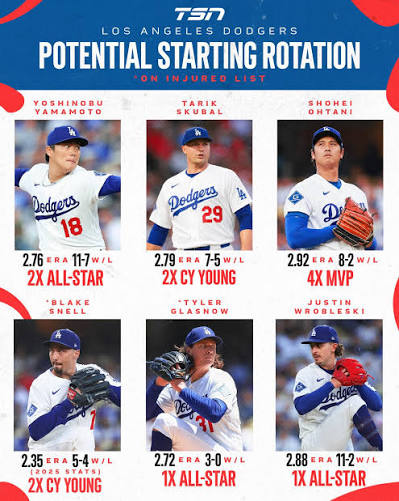
The Dodgers are not trying to win a World Series. They are trying to become the first National League team to win three consecutive World Series championships. They acquired Skubal from Detroit for outfielder Zyhir Hope and pitchers River Ryan and Brady Smith, giving up three highly regarded prospects without dismantling the strongest parts of their farm system or young major league roster.
That is ridiculous.
But is it ruining baseball?
I don’t think so.
At least not yet.
Baseball Is Still Baseball
The first reason is simple: Baseball might be the most unpredictable of our major sports.
A great NBA team can overwhelm an inferior opponent during a seven-game series. The better roster usually has enough possessions and enough opportunities for its talent to take control.
Baseball does not always work that way.
One starting pitcher can dominate. A great hitter can go 2-for-20. A routine ground ball can hit the bag. A bullpen can collapse. A team can score 10 runs one night and barely make contact the next.
Research comparing the major American sports has found that Major League Baseball stands out for the amount of randomness involved in individual game outcomes. Even the best teams lose a significant number of games during the regular season, and that uncertainty becomes especially important during a short postseason series.
The Dodgers themselves should understand that better than anyone.
They were one swing, one pitch or one defensive mistake away from losing last year’s World Series. Toronto took them to Game 7, held a three-run lead early and was one out away from winning the championship before Los Angeles tied the game in the ninth. The Dodgers eventually survived 5-4 in 11 innings.
That was not a coronation.
That was an escape.
Adding Skubal makes the Dodgers better. It does not make them unbeatable.
We Have Seen This Before
The Dodgers are also not the first baseball team to become the sport’s financial supervillain.
The Yankees spent much of the late 1990s and early 2000s collecting stars, carrying massive payrolls and turning every road series into an event. Fans complained then, too. The Yankees were accused of buying championships and destroying competitive balance.
They won three straight championships from 1998 through 2000.
Then they didn’t win another one until 2009.
Arizona beat them in the 2001 World Series. The Florida Marlins beat them in 2003. Boston completed its historic comeback against them in 2004. New York eventually missed the playoffs entirely in 2008.
The Yankees had more money than almost everyone. They had stars all over the field.
They still lost.
They did not ruin baseball. They gave baseball a villain.
There is value in that. Fans need teams they desperately want to beat. A dominant franchise can create interest, ratings and emotion.
Nobody was indifferent to those Yankees.
Nobody is indifferent to these Dodgers.
But Let’s Not Pretend the Money Doesn’t Matter
This is where the conversation gets more complicated.
The Dodgers are not cheating. They are not secretly ignoring baseball’s rules. They are using the system MLB and the Players Association negotiated.
Ohtani’s contract, including $680 million in deferred payments, was permitted under the collective bargaining agreement. There is no rule limiting how much salary can be deferred. The Dodgers’ overall deferred obligations have since climbed beyond $1 billion.
They are also paying a price for their spending.
MLB’s competitive balance tax threshold is $244 million in 2026. Spotrac projects the Dodgers’ tax payroll at more than $400 million, with a tax bill that could exceed $160 million.
So, no, they are not avoiding every consequence.
The problem is that they can afford the consequences.
Los Angeles can sign expensive free agents, absorb injuries, pay luxury taxes, defer hundreds of millions of dollars and still invest heavily in scouting and player development. When a risky opportunity presents itself, the Dodgers can take that risk without threatening the organization’s long-term survival.
That matters.
The Skubal trade itself was not simply the Dodgers purchasing another player. They acquired him with prospects. Other contenders had the talent and financial ability to make competitive offers.
The Dodgers were willing to act.
They should receive credit for that.
But their financial power makes it easier to act fearlessly. If Skubal leaves after three months, the Dodgers will still have a loaded roster, a deep farm system and the money to pursue the next superstar.
A smaller-market organization cannot always recover from that kind of gamble.
The Real Problem Is the Feeling
Milwaukee manager Pat Murphy summed up the imbalance when he described a potential matchup between the Brewers and Dodgers as “David and Goliath.”
That does not mean David cannot win.
It means everyone already understands which team gets to be Goliath.
That is where the Dodgers become a problem for baseball.
Not because they are guaranteed to win. They are not.
Not because they have done something illegal. They haven’t.
The problem is that having enough money to collect many of the sport’s best players takes some of the fun out of the competition before the games even begin.
Fans in Milwaukee, Tampa Bay, Pittsburgh, Cincinnati or Kansas City should not feel as though their favorite team must be nearly perfect just to have a temporary opportunity to compete against an organization that can simply reload every winter.
Every owner does not need to spend like the Dodgers. Some owners use competitive balance as an excuse to protect their profits, and a salary cap without a meaningful salary floor would do little more than suppress player salaries.
But baseball needs a system that encourages every organization to invest, allows well-run smaller-market teams to retain more of their own stars and prevents the largest financial advantages from becoming overwhelming.
That debate is coming quickly. The current collective bargaining agreement expires on Dec. 1, 2026, and competitive balance is expected to be one of the central issues between MLB and the players.
So, Are They Ruining Baseball?
No.
The Dodgers are operating within the rules. They develop players, identify talent, make smart trades and spend aggressively. Other organizations should be trying to match their competence instead of simply complaining about it.
And baseball remains too unpredictable to hand anyone a championship in August.
But the Dodgers are exposing the weaknesses in MLB’s economic system.
They are not ruining baseball.
They are making baseball feel less fair.
There is a difference.
The Dodgers can still lose. In fact, history tells us there is a pretty good chance they eventually will.
But when one organization can add the best pitcher available to what might already be baseball’s best rotation, while carrying more than $1 billion in deferred obligations and a tax payroll north of $400 million, fans are justified in wondering whether the playing field has tilted too far.
That does not mean the Dodgers should apologize.
It means Major League Baseball needs to decide how tilted it is willing to let that field become.


Leave a Reply